
Guide to Small-Scale Growing of Heritage Grains
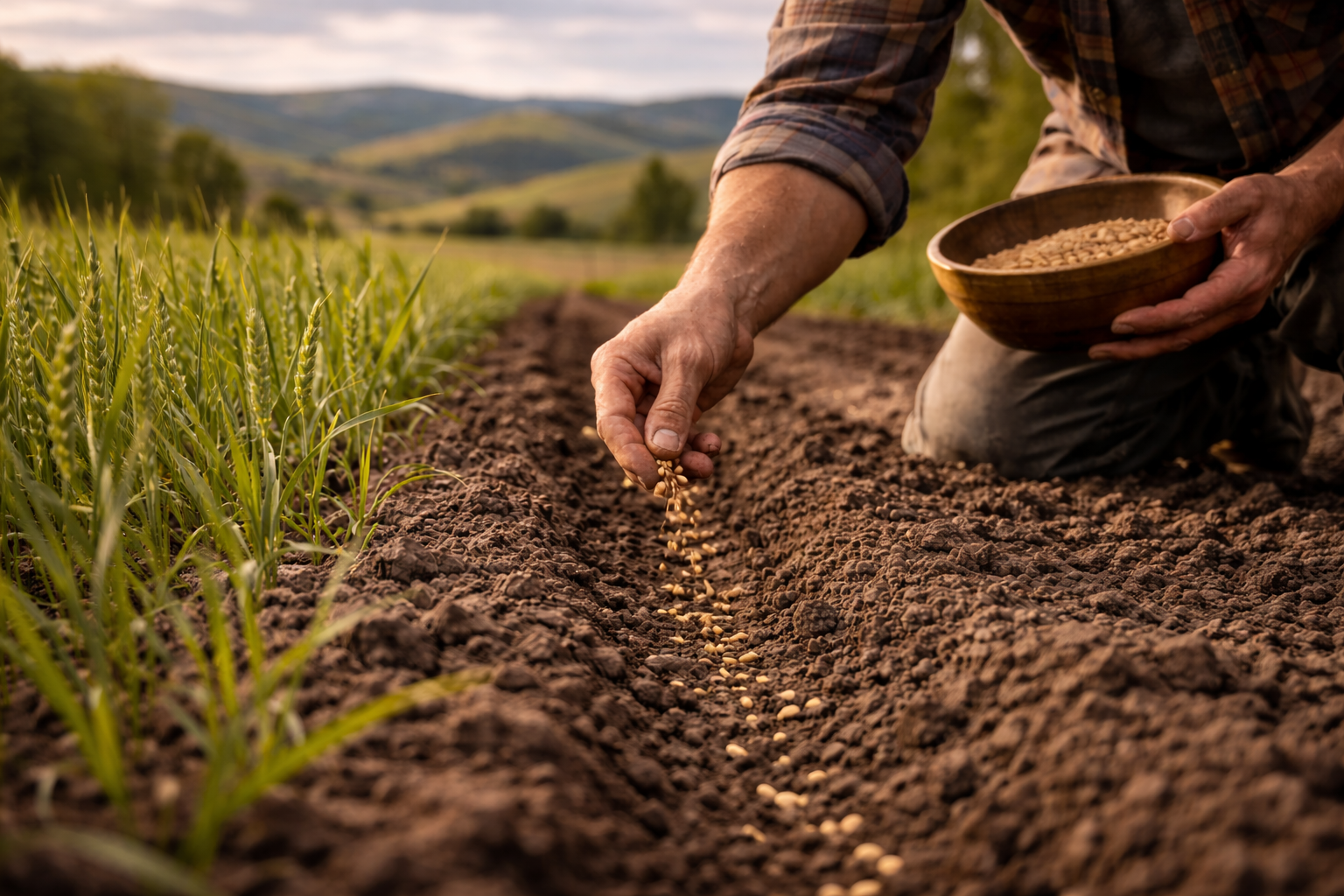
There’s something deeply satisfying about growing your own grain.
For thousands of years, families around the world grew small plots of wheat or barley that were harvested, threshed, and milled close to home. Today, more people are rediscovering this connection by planting small plots in gardens, on homesteads, or on a few acres.
We’re frequently asked by homesteaders, home gardeners, and friends how they might grow small plots of heritage grains themselves. This guide grew out of those conversations. So if you, too, are curious about growing heritage wheat or barley yourself, this guide walks through the basic steps. It’s designed for small plots, backyard growers, and garden-scale production.
This isn’t about maximizing yield.
It’s about learning, resilience, and reconnecting with the grain traditions that sustained generations before us.
Site Selection & Soil Preparation
Choose the Right Spot
Look for a planting area with:
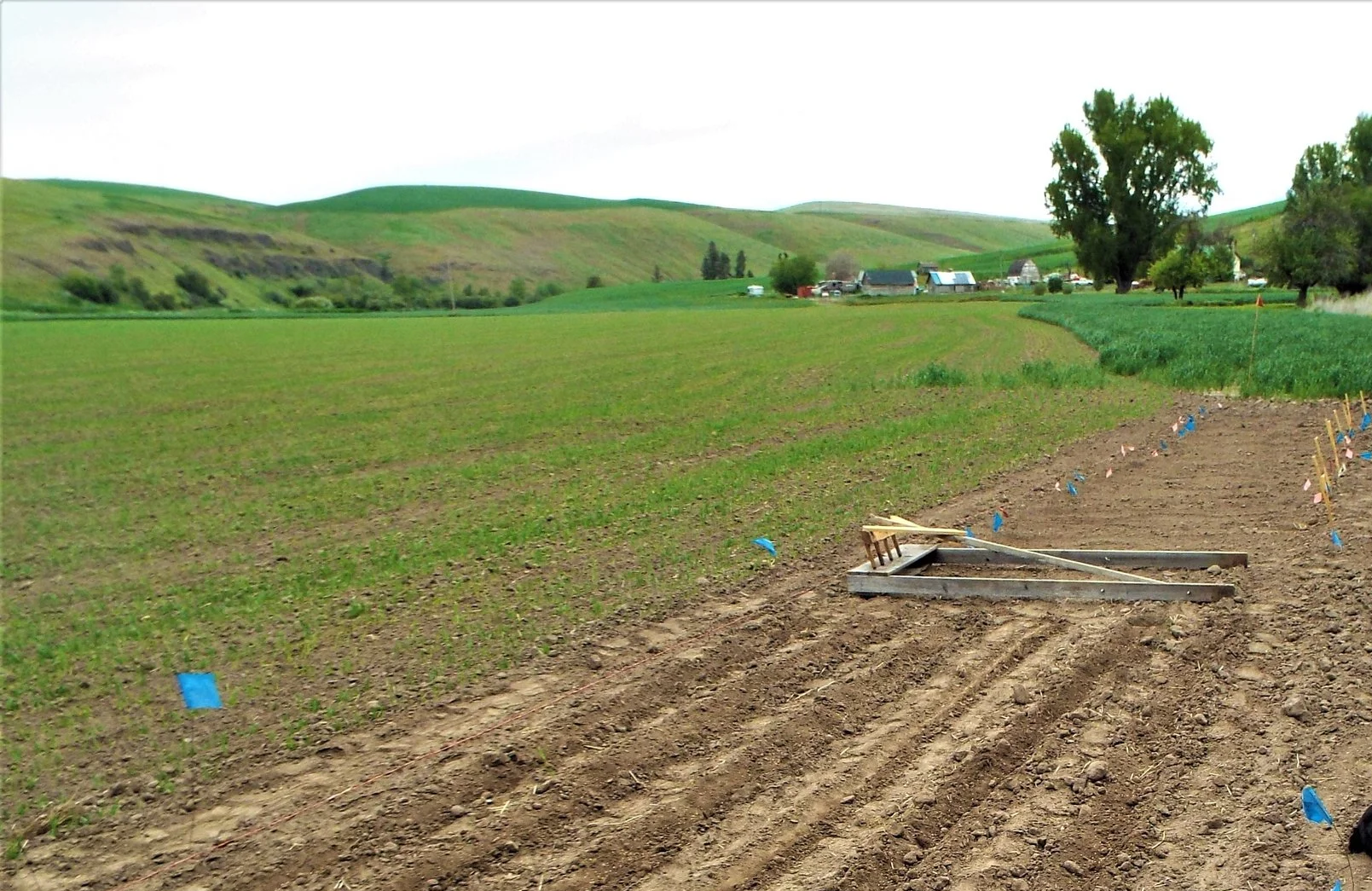
Prepping small grain plots at our Palouse Colony Farm
Full sun (minimum 6–8 hours daily)
Well-drained soil
Minimal soil compaction
Grains prefer soil that drains well and allows roots to develop deeply.
Small-Scale Soil Preparation Tools
For garden-scale plots, simple hand tools work well:
Broadfork (ideal)
Garden fork
Stirrup hoe
A rototiller can be used when first transitioning ground to grain production, but it should not be used repeatedly because it:
Breaks down soil structure
Disrupts fungal networks important for grain roots
Brings dormant weed seeds to the surface
Can create a hardpan layer beneath the till depth
Burns organic matter over time
Finish preparation by raking the surface smooth.
Your goal is a fine, firm seedbed, similar to what you would prepare for carrots.
Soil Conditions Grains Prefer
Most wheat and barley perform well in:
Neutral to slightly acidic soil (pH 6–7)
Moderate nitrogen levels
Avoid over-fertilizing. Too much nitrogen can lead to weak stems and lodging (grain falling over).
💡 If you use compost, incorporate it a few weeks before planting.
Seeding Rates for Small Plots
Wheat
~ 1–1.5 lbs per 100 sq ft
Roughly 90–110 lbs per acre equivalent
Barley
Similar to wheat
Slightly lighter seeding rates also work well
How to Plant Without Equipment
Most small growers plant by hand using one of two methods.
Method 1: Hand Rows (Preferred)
This method provides better weed control.
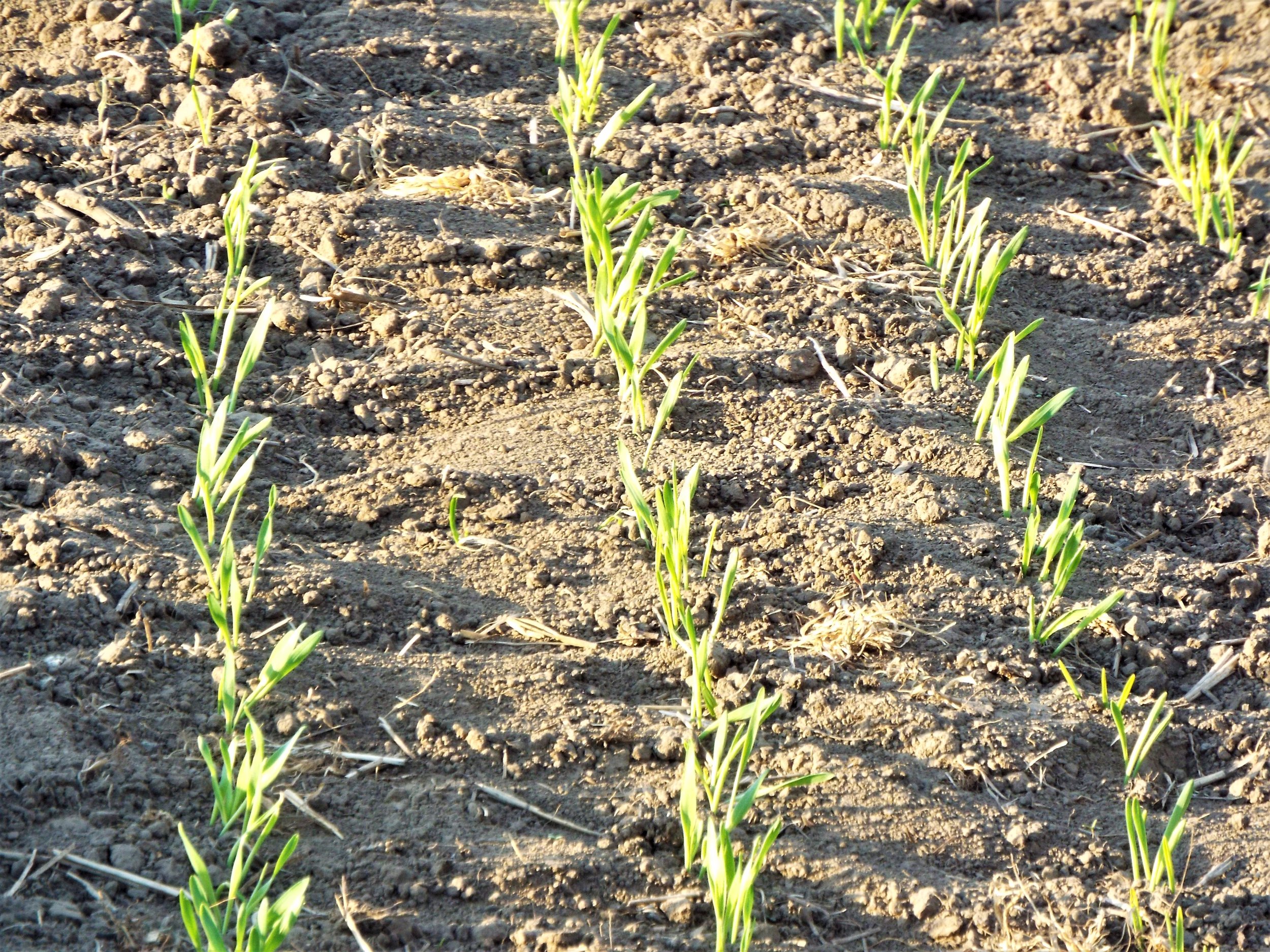
Heritage grains planted in hand rows
Steps:
Space rows 5–7 inches apart
Plant seeds about 1 inch deep
Place one seed every ~4 inches
Rake soil lightly to cover
Rows make it easier to weed early in the season.
Method 2: Broadcast + Rake (Most Common)
This is the traditional method used by many small growers.
Scatter seed evenly by hand
Rake seeds into soil ½–1 inch deep
Firm the soil by:
Using a lawn roller
Walking across the plot
Tamping with a board
After planting, water the plot to encourage germination.
Weed Management
(The Biggest Small-Scale Challenge)
Heritage grains are resilient, but weeds are still the main competition.
During the first 2–6 weeks:
Use a stirrup hoe between rows
Hand weed once or twice
Keep the canopy clean early
Once the grain begins tillering, it competes with weeds much more effectively.
Fall-planted wheat often suppresses spring weeds better.
Water Needs
In the Palouse climate where we live, grain often grows successfully as a dryland crop.
For other regions:
Avoid waterlogged soils
Irrigation is usually unnecessary once plants are established
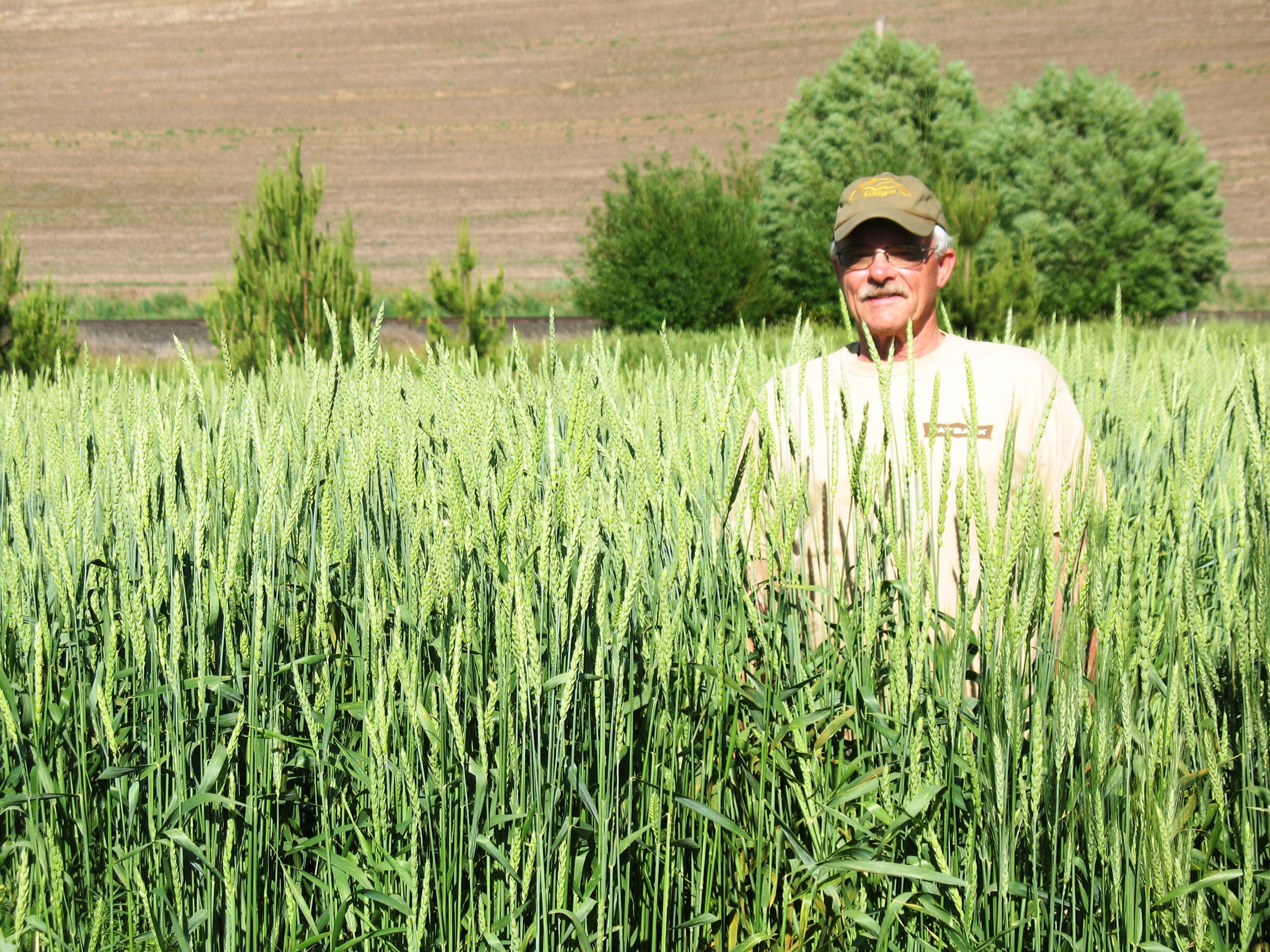
Heritage wheat can grow much taller than modern wheat, which increases risk of lodging. In this photo, our co-founder Don, who is well over 6 feet tall, is standing in a field of heritage wheat that is approaching his height!
For garden plots in dry areas:
Water during germination
Then allow roots to chase moisture deeper
Too much water can cause lodging, where plants fall over before harvest.
Harvesting Without Large Equipment
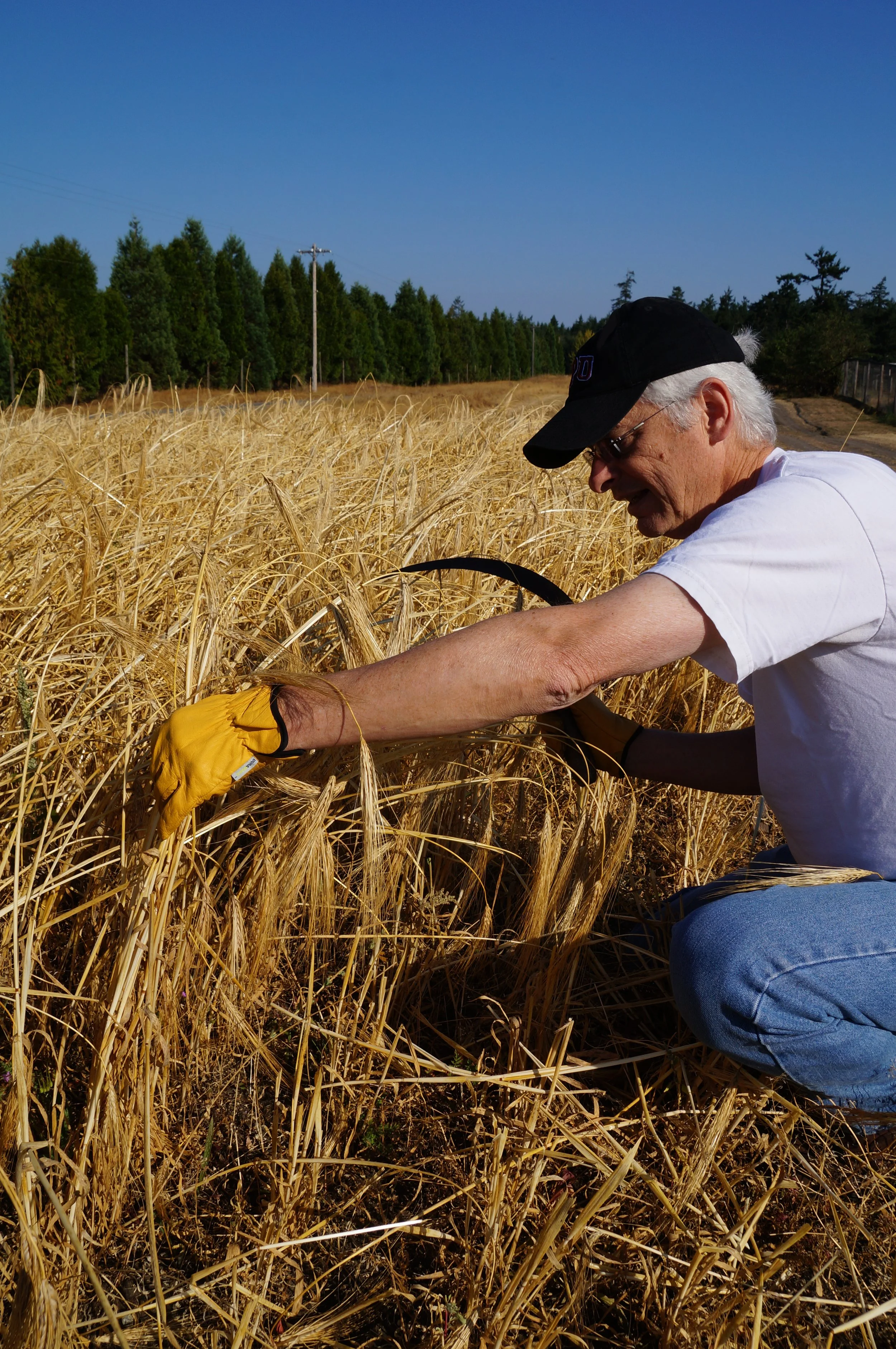
Palouse Heritage co-founder, Richard, cuts heritage grain by hand using a sickle.
Harvesting grain on a small scale is surprisingly simple.
Tools You Can Use
Sickle
Sharp serrated knife
Hand pruners (for very small plots)
Scythe
When to Harvest
Grain is ready when:
Heads are fully golden
Kernels are hard and cannot be dented with a fingernail
Stems are mostly dry
After cutting, bundle stems into small sheaves and allow them to dry 1–2 weeks.
Threshing & Cleaning (Low-Tech Methods)
First: Make Sure Grain Is Truly Dry
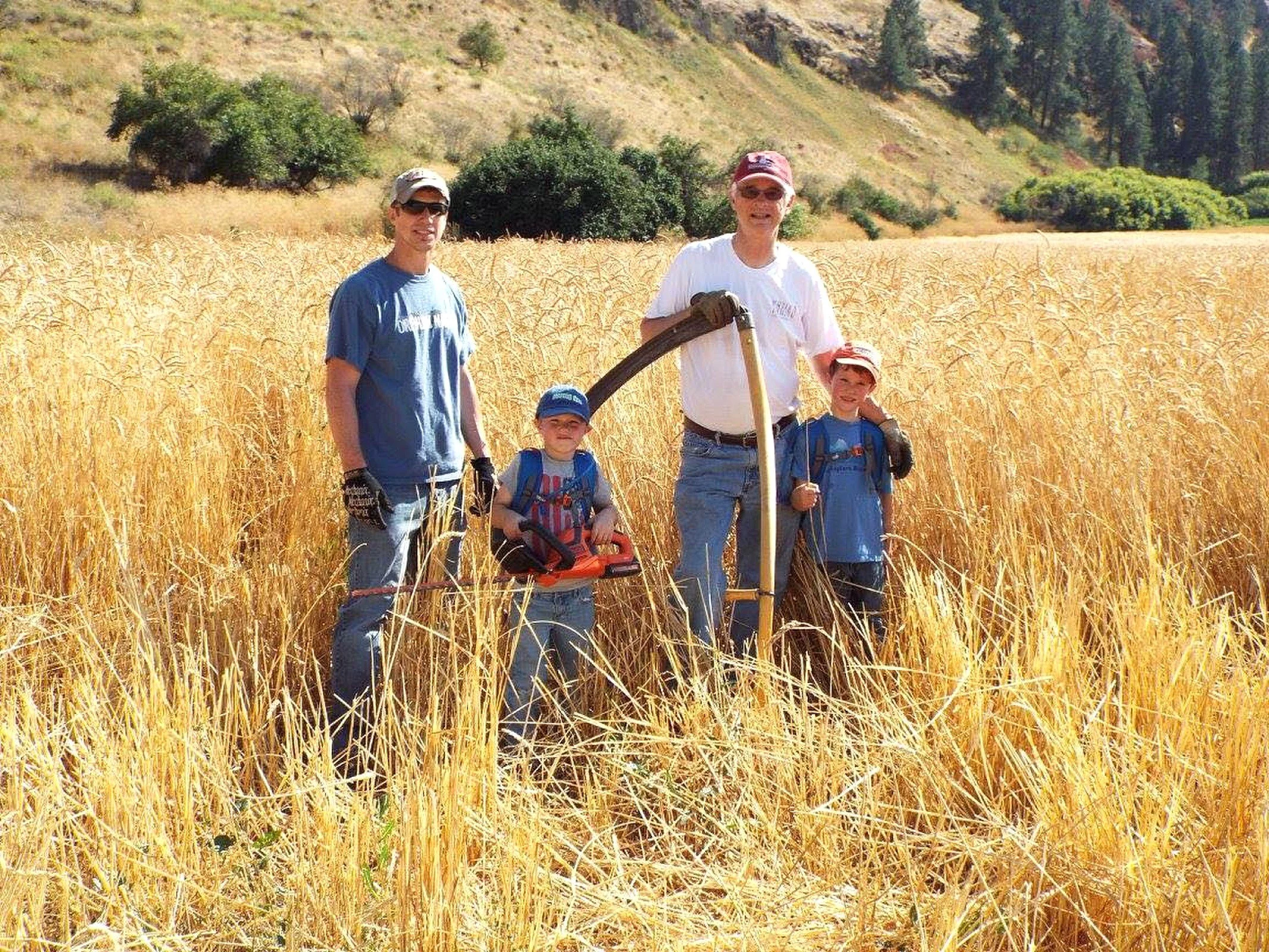
Members of our Scheuerman using any means necessary to cut a heritage grain plot (scythe, hedge trimmer 😆, etc.)
Before threshing:
Heads fully golden
Kernels hard
Stems dry and brittle
Moisture ideally below ~13%
If unsure, let bundles dry another 1–2 weeks in a shed or garage.
Threshing too early creates a gummy mess and poor storage life.
Threshing Methods
Threshing simply means knocking kernels out of the seed head.
Method 1: 5-Gallon Bucket + Stick
Best for: small backyard plots
Steps:
Place dry heads in bucket (don’t overfill)
Beat with a stick, dowel, or broom handle
Twist and rub heads to release kernels
You’ll end up with:
Loose kernels
Chaff
Small stem pieces
Dump onto a tarp and repeat.
Method 2: Tarp Stomp Method
Best for slightly larger plots.
Lay grain heads on a tarp
Fold tarp over
Walk or stomp evenly
Flip and repeat
Surprisingly effective.
Method 3: Trash Can + Mechanical Agitation
For larger backyard harvests:
Clean metal trash can
Weed trimmer head (plastic only)
Drill with paint mixer attachment
These increase efficiency but require caution.
Special Note: Hulled Barley
Some heritage barleys are hulled varieties.
After threshing, the grain still has a tight hull attached and must be dehulled.
Small-scale options include:
Certain home mills
Small impact dehullers
Cracking hulls lightly and winnowing repeatedly
Winnowing (Removing Chaff)
Winnowing separates grain from plant debris using weight differences.
Method 1: Box Fan (Most Reliable)
Setup:
Box fan on low
Tarp or tote below
Pour grain slowly between containers in front of the fan.
Heavy grain falls straight down
Light chaff blows away
Repeat 2–4 passes.
This is the easiest method for most home growers.
Method 2: Natural Breeze
On a light wind day:
Pour grain between buckets
Let the wind carry away the chaff
This is the traditional method used for thousands of years.
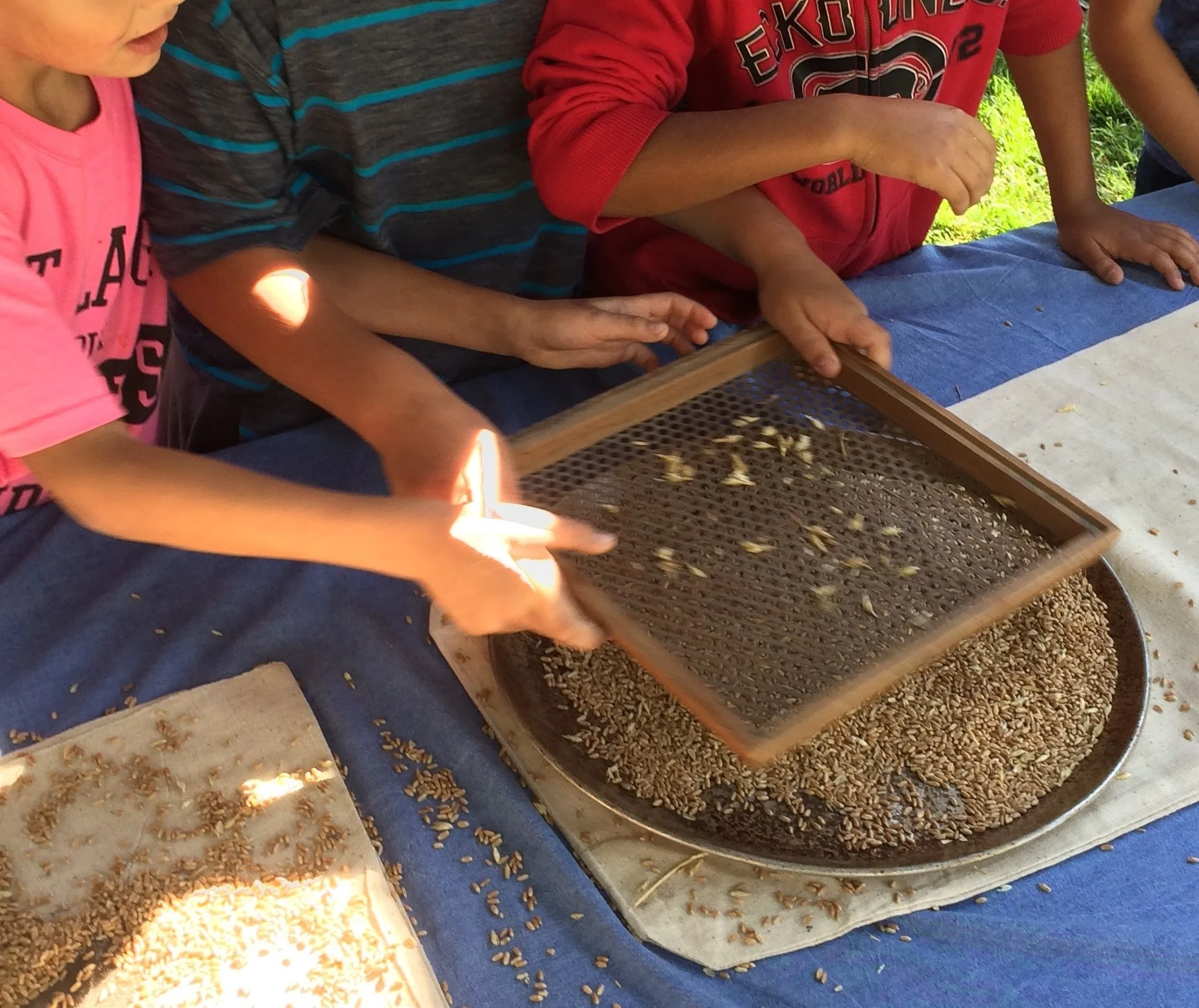
Kids winnowing grain with the aid of a grain screen, which can also help make winnowing easier.
Method 3: Screen First
Before winnowing:
Run grain through ¼-inch hardware cloth
Remove larger stem pieces
This makes air cleaning much easier.
How Clean Is “Clean Enough”?
For home milling, a little chaff is fine.
Small debris usually separates during milling.
For saving seed, grain must be cleaner:
Remove broken kernels
Keep only full, heavy grain
Storage After Cleaning
Store in:
Food-grade buckets
Glass jars
A cool, dry place
Oxygen absorbers are optional.
Moisture is the enemy. If you are concerned your grain may have moisture, spread it out into a thin layer and allow it to air dry for a few days if feasible before storing.
What Makes Heritage Grain Different?
Heritage wheat often behaves differently from modern varieties:
Taller straw makes harvesting easier, but increased risk of lodging
Heads tend to thresh more easily
Stronger heads resist shattering in small plots
These traits make heritage grains surprisingly well suited for small-scale growing.
Troubleshooting
Grain still stuck in the head
→ It probably wasn’t dry enough.
Too much chaff left after cleaning
→ Increase fan speed slightly or pour from higher.
Grain cracking during threshing
→ Threshing too aggressively.
Mold smell in storage
→ Grain was stored too wet.
Yield Expectations
Small plots rarely match commercial farm yields.
Typical expectations:
100 sq ft → 5–10 lbs cleaned grain
¼ acre → 150–300 lbs
The goal here isn’t maximizing bushels.
It’s learning, resilience, and reconnecting with the land.
Common Beginner Mistakes
Planting too shallow
Planting too sparse
Ignoring weeds early
Overwatering
Harvesting too early
Best Practices
Use cover crops between grain cycles
Avoid synthetic nitrogen on small plots when possible
Save seed from the best-performing plants
Maintain varietal purity by not mixing varieties unintentionally
Growing grain on a small scale offers a deeper appreciation for the crops that sustain us. Whether you’re planting a backyard plot or experimenting on a small acreage, the process reconnects us to an agricultural rhythm that has shaped civilizations for thousands of years.
If you’re interested in planting heritage varieties like Turkey Red wheat, White Sonora wheat, or English Redhead, we offer those grain seeds grown from right here in the Palouse. You can get them from our store.
Happy growing!
